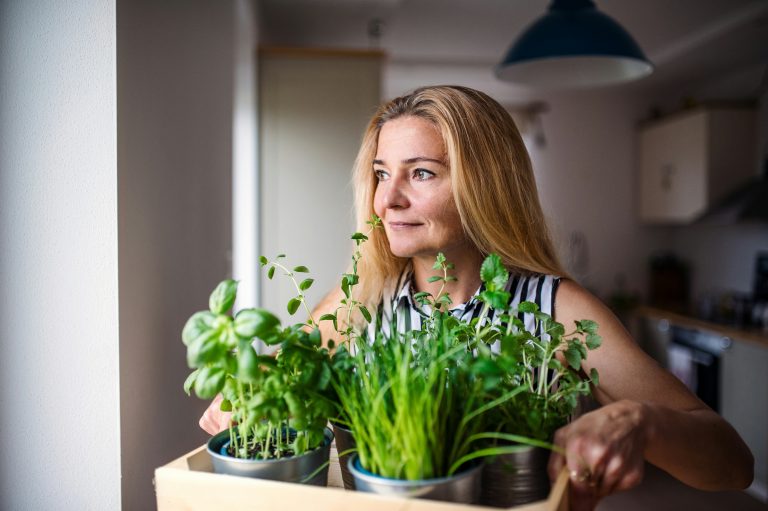
How to Grow Herbs Indoors in an Apartment (Even Without a Sun-Facing Window)
You can grow herbs indoors in an apartment with basic equipment you probably already own. You need a container, decent potting mix, a water source, and enough light — either from a window or a grow light. That’s it. This article walks you through exactly what to do, what to buy, and what to avoid.
I started growing herbs on a rented balcony with a north-facing aspect — I’m based in New Zealand, where north-facing gets the most sun. Most of what I’ll tell you here comes from that experience: figuring out what actually works when you don’t have ideal conditions.
What You Actually Need to Get Started
You need four things: a container with drainage, a quality potting mix, light (natural or artificial), and water. That’s the full list.
You do not need:
- A south-facing window (in the Northern Hemisphere) or north-facing window (in the Southern Hemisphere) — though it helps
- Special herb starter kits
- An outdoor space
- A green thumb
The herbs that suit apartments are also the herbs most people actually want in a kitchen: basil, mint, parsley, chives, coriander. These are accessible, grow quickly enough to stay interesting, and tolerate the variable conditions of a rental.
One note before you buy anything: if you’re coming to this after reading Homesteading for Renters: What You Can Actually Do Without Owning Land, you already know the mindset — work with the space you have, not the one you want. That applies directly here.
The Best Herbs for Indoor Apartment Growing
Not all herbs want the same conditions. Grouping them by light requirement is the most useful way to think about this, because your window situation will determine which tier is available to you without extra equipment.
Here’s a quick reference:
| Herb | Light Requirement | Notes |
|---|---|---|
| Basil | High (6+ hours direct) | Sulks in low light; bolts fast in heat |
| Coriander/Cilantro | High (6+ hours direct) | Bolts quickly; grow in succession |
| Chives | Medium–Low (3–4 hours) | Very forgiving; regrows well after harvest |
| Mint | Medium–Low (3–4 hours) | Invasive in ground; contained in pots |
| Parsley | Medium–Low (3–4 hours) | Slow germinator; buy seedlings to start |
| Rosemary | Needs grow light indoors | Struggles without high consistent light |
| Thyme | Needs grow light indoors | Same as rosemary; Mediterranean origin |
| Oregano | Needs grow light indoors | Leggy and weak without strong light |
Herbs That Thrive in Good Light (South/West Window — Northern Hemisphere; North/West — Southern Hemisphere)
Basil is the herb most people want to grow indoors and the most demanding. It needs at least 6 hours of direct sunlight per day. In the Northern Hemisphere, a south-facing windowsill delivers this; in the Southern Hemisphere (NZ, Australia), a north-facing window is the equivalent. West-facing windows work in both hemispheres if they get strong afternoon sun. Grow ‘Genovese’ for cooking; ‘Spicy Globe’ for compact growth in smaller pots.
Coriander (cilantro) also wants 6 or more hours of direct light. It has a short life cycle and bolts to seed quickly, especially in warm indoor conditions. Rather than growing one large plant, sow a few seeds every 3–4 weeks so you always have something at a usable stage.
How much light do indoor herbs need?
Most herbs need 4–6 hours of direct light per day; low-light varieties like mint, chives, and parsley can manage on 3–4 hours, while high-demand herbs like basil need 6 or more.
Mint is the most forgiving herb for indoor growing. It handles 3–4 hours of indirect or filtered light and bounces back fast after harvest. Keep it in its own container — mint spreads aggressively and will crowd out anything grown with it. ‘Spearmint’ and ‘Peppermint’ both do well indoors.
Chives are equally tolerant and one of the most useful herbs to keep on hand. They regrow reliably after cutting, need only 3–4 hours of light, and are genuinely hard to kill in normal apartment conditions. Grow in a 10–15cm pot and they’ll provide for months.
Parsley (flat-leaf ‘Italian’ variety or curly) grows slowly but tolerates lower light than most people expect — 3–4 hours is workable. It has a long taproot, so use a pot that’s at least 20–25cm deep. Note: parsley is notoriously slow from seed (3–6 weeks to germinate). Buy a seedling if you want results this season.
Herbs That Need a Grow Light to Do Well
Rosemary, thyme, and oregano are Mediterranean herbs. In their natural habitat, they get full sun for most of the day. Indoors, even a good window rarely delivers the light intensity they need to thrive. They don’t die quickly — they decline slowly, getting leggy and losing flavour. If you want these herbs producing well indoors, a grow light is the honest answer.
A full-spectrum LED grow light running 14–16 hours per day will get these herbs to a productive state. Position the light 15–30cm above the plant canopy and use a timer so you’re not relying on memory. Budget grow lights in the $50–$80 range can work, but check that the product specifies “full-spectrum” — lights marketed only by wattage without spectral information are often inadequate.
Setting Up Your Indoor Herb Garden: Step by Step
Here’s what you actually need to buy and how to put it together.
Choosing Containers and Drainage
Drainage is the most important structural decision. A pot without drainage holes will drown your herbs — no matter how carefully you water. If you have a pot you like that lacks drainage, drill holes in the base or use it as an outer decorative sleeve with a drilled pot sitting inside it.
Pot sizes that work:
- Chives, mint: 10–15cm diameter
- Basil, coriander: 15–20cm diameter
- Parsley, rosemary, thyme: 20–25cm diameter (deeper for parsley)
Terracotta pots are good for Mediterranean herbs (rosemary, thyme, oregano) because they breathe and dry out faster, which suits those herbs. Plastic pots retain moisture longer, which works well for mint and parsley. Either material is fine for basil and chives.
If you’re growing multiple herbs on a windowsill and want a tray to protect the surface, use a tray with a layer of pebbles underneath the pots. This prevents the pots from sitting in standing water while still containing any drainage runoff.
Soil Mix for Indoor Herbs
Do not use garden soil for indoor herbs. It compacts in pots, drains poorly, and can introduce pests. Use a quality peat-free potting mix as your base.
For Mediterranean herbs (rosemary, thyme, oregano), mix standard potting mix 50/50 with perlite or coarse sand to improve drainage and prevent root rot. These herbs genuinely struggle in soil that stays damp.
For mint, parsley, basil, and chives, a standard potting mix without amendment is fine — just ensure the pot drains freely.
Skip fertilising for the first month if you’re planting into fresh potting mix. Most commercial mixes include starter nutrients. After that, a diluted liquid fertiliser (half-strength) once every 3–4 weeks is enough. Over-fertilising pushes leafy growth that tastes weak.
Placement: Windows vs. Grow Lights
Window placement: Place your highest-light herbs (basil, coriander) as close to the glass as possible without touching it. In the Northern Hemisphere, south- or west-facing windows are your first choice; in the Southern Hemisphere (NZ, Australia), north- or west-facing windows provide the most sun. East-facing windows deliver gentler morning light — usable for low-light herbs but insufficient for basil.
Rotate your pots a quarter-turn every few days. Indoor herb plants lean toward light sources and rotating them helps them grow more evenly.
Grow lights: Mount the light so the canopy sits 15–30cm below the fixture. Run it on a timer: 14–16 hours on, 8–10 hours off. This mimics a long summer day, which is what Mediterranean herbs need to produce well. Avoid leaving grow lights on 24 hours — plants need a dark period.
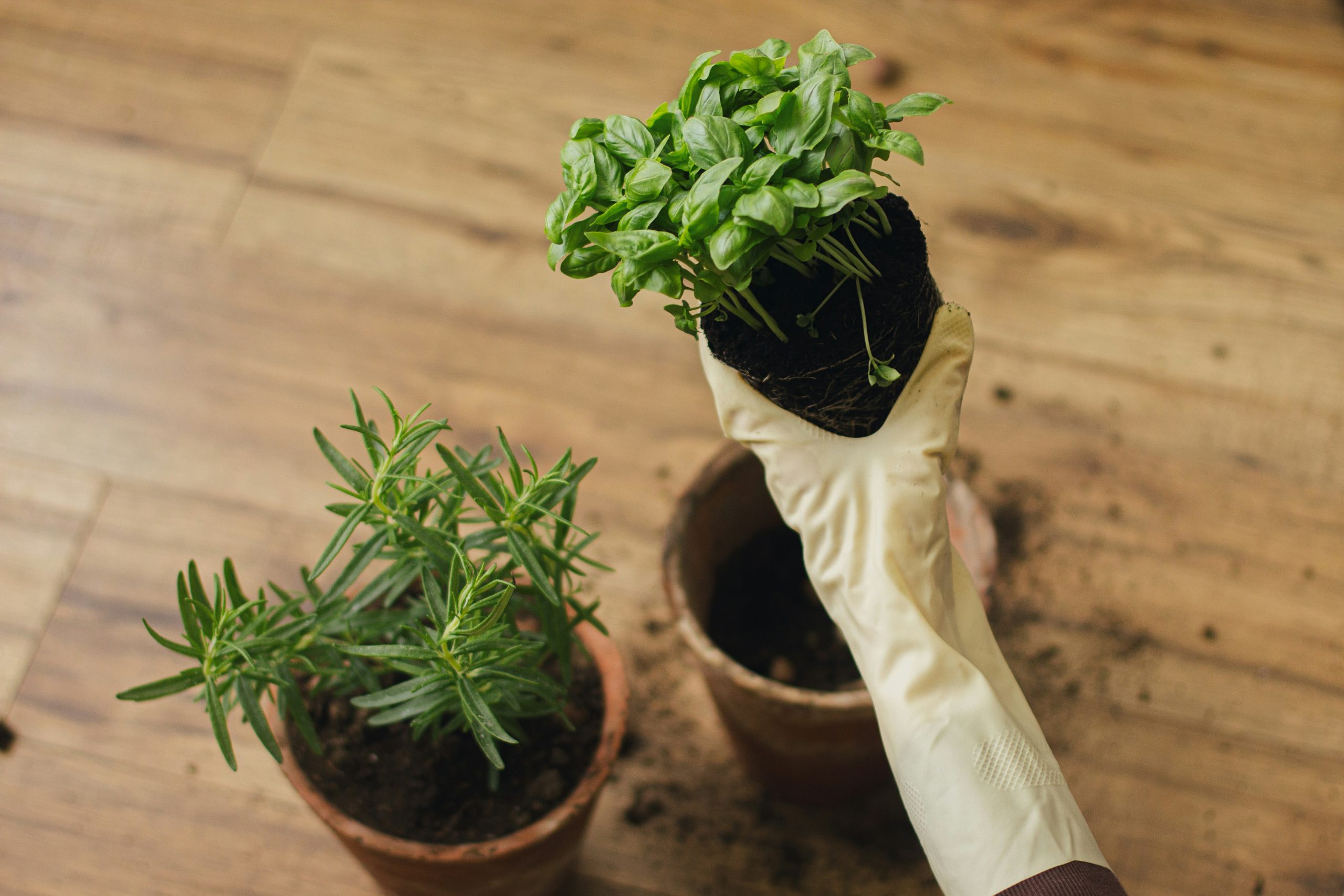
A note on supermarket herb plants: they’re grown in controlled greenhouse conditions with high light and optimum nutrition, often with multiple seedlings crammed into a single small pot. When you bring one home, the first thing to do is repot it. Separate the seedlings and put each one into its own container with fresh potting mix. The transition will stress the plant for a week or two, but it’ll stabilise and grow better than if you left all the seedlings competing for the same pot.
If you’re setting up your first indoor herb garden, our guides for apartment growers cover container selection, soil mixes, and what to grow in low-light apartments — all in one place.
How to Water Indoor Herbs Without Killing Them
Overwatering kills more indoor herbs than underwatering. The instinct to water on a schedule is the wrong approach — soil dries at different rates depending on pot size, material, temperature, and season.
Use the finger test: push your finger about 2cm into the soil. If it’s dry at that depth, water thoroughly. If it’s moist, wait. Water until it drains out the bottom of the pot, then empty the saucer — don’t let the pot sit in standing water.
How often this happens in practice:
- Summer, terracotta pot, basil: possibly every day
- Winter, plastic pot, mint: possibly every 4–5 days
The frequency varies. The test is the same.
Signs of overwatering: yellowing leaves, soft stems, soil that stays wet for a week or more. Signs of underwatering: dry, crispy leaf edges, wilting despite soil being completely dry. Both are fixable early; both kill the plant if ignored long enough.
Harvesting Without Damaging the Plant
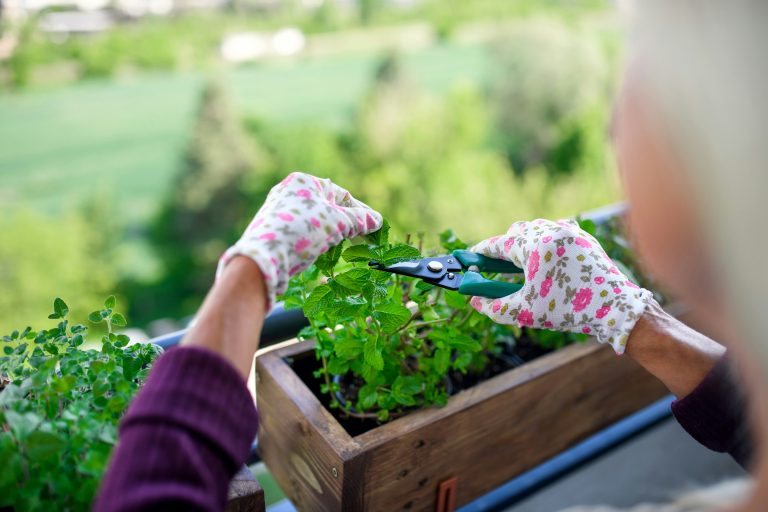
The rule is simple: cut above a leaf node, never remove more than one-third of the plant at once.
A leaf node is the point on the stem where leaves branch off. Cutting just above a node (leaving the node on the plant) encourages the plant to branch from that point, producing a fuller, bushier plant over time. Cutting below a node, or cutting a stem entirely off at soil level, removes the growth point and the plant can’t recover from that cut.
For basil specifically: pinch out flower heads the moment they appear. Once basil flowers (bolts), the leaves become bitter and the plant stops producing new growth. Keep pinching the top sets of leaves and the flower buds and the plant will stay in leaf production for months.
For chives: cut the leaves down to about 3–4cm above soil level. They’ll regrow completely.
For mint: harvest from the tips, cutting the top 2–3 sets of leaves. This keeps the plant compact and productive rather than leggy.
For parsley: cut the outer stems first, leaving the inner growth to continue developing.
Common Beginner Mistakes (and How to Avoid Them)
Overwatering. The most common. The finger test solves it — 2cm into the soil, if moist, wait.
Too little light for the wrong herb. Basil in a north-facing window (Northern Hemisphere) or south-facing window (Southern Hemisphere) will survive but won’t thrive. Match the herb to the light you actually have, or add a grow light.
Pots without drainage. Standing water in the base of a pot causes root rot within days in warm conditions. Always check for drainage holes.
Planting multiple herbs in one pot. It looks good in a photo. In practice, mint takes over everything, herbs with different watering needs end up on the wrong side of that balance, and roots compete. Separate pots, labelled, is the practical approach.
Leaving supermarket herb plants as-is. Those small pots contain 6–10 seedlings. Repot them individually into fresh potting mix within a day or two of buying them.
Harvesting too aggressively. Never more than one-third of the plant at once. Taking half the plant thinking you’ll get more herb out of it faster just shocks the plant and halts growth for weeks.
Fertilising too early or too often. Fresh potting mix has nutrients in it. Wait a month, then fertilise sparingly — half-strength, once every 3–4 weeks. Over-fertilised herbs grow fast but taste bland.
From Windowsill to Kitchen: How to Actually Use What You Grow
The point of growing kitchen herbs is using them. The most common failure mode I see is growing more than you use, letting the plant bolt or become overgrown, and then abandoning it.
Here’s what keeps the cycle going:
Use fresh herbs daily in small amounts. A few leaves on eggs, a handful of chives on soup, basil leaves on a sandwich. The more you harvest in small amounts, the more the plant produces.
Dry or freeze what you can’t use fresh. Harvest a large bunch of parsley or mint before it goes to seed, rinse, dry well, and either hang-dry in a dark spot for a week or freeze the leaves flat on a tray then transfer to a bag. Frozen herbs lose texture but retain flavour and are perfect for cooking (not garnishing).
Basil: make oil or pesto. Basil doesn’t dry well — it turns black and loses flavour. When you have a glut, blend it with olive oil and freeze in ice cube trays. One cube per serving, all winter.
Mint: make tea. Strip fresh leaves into a mug, add boiling water, steep for 5 minutes. That’s mint tea. No equipment, no drying time, no preparation.
Coriander: use roots and stems too. Most people discard the roots and stems and only use the leaves. The stems have more flavour than the leaves, and the roots (rinsed well) are used in Thai cooking pastes. Nothing goes to waste.
The goal isn’t a perfect herb garden display. It’s usable ingredients on the bench when you need them. Start with two herbs you actually cook with. Get those right. Add more from there.
Growing your own herbs is just the start — the Starter Kit covers the next steps: preserving what you grow, saving seeds, and building a small-space food system that keeps producing.
The No-Land Homesteader’s Starter Kit is a 45-page practical guide — container gardening, composting in small spaces, seed-saving, fermentation, and food preservation — built specifically for renters and apartment dwellers. $17.